1. What is a Mass Haul Diagram?
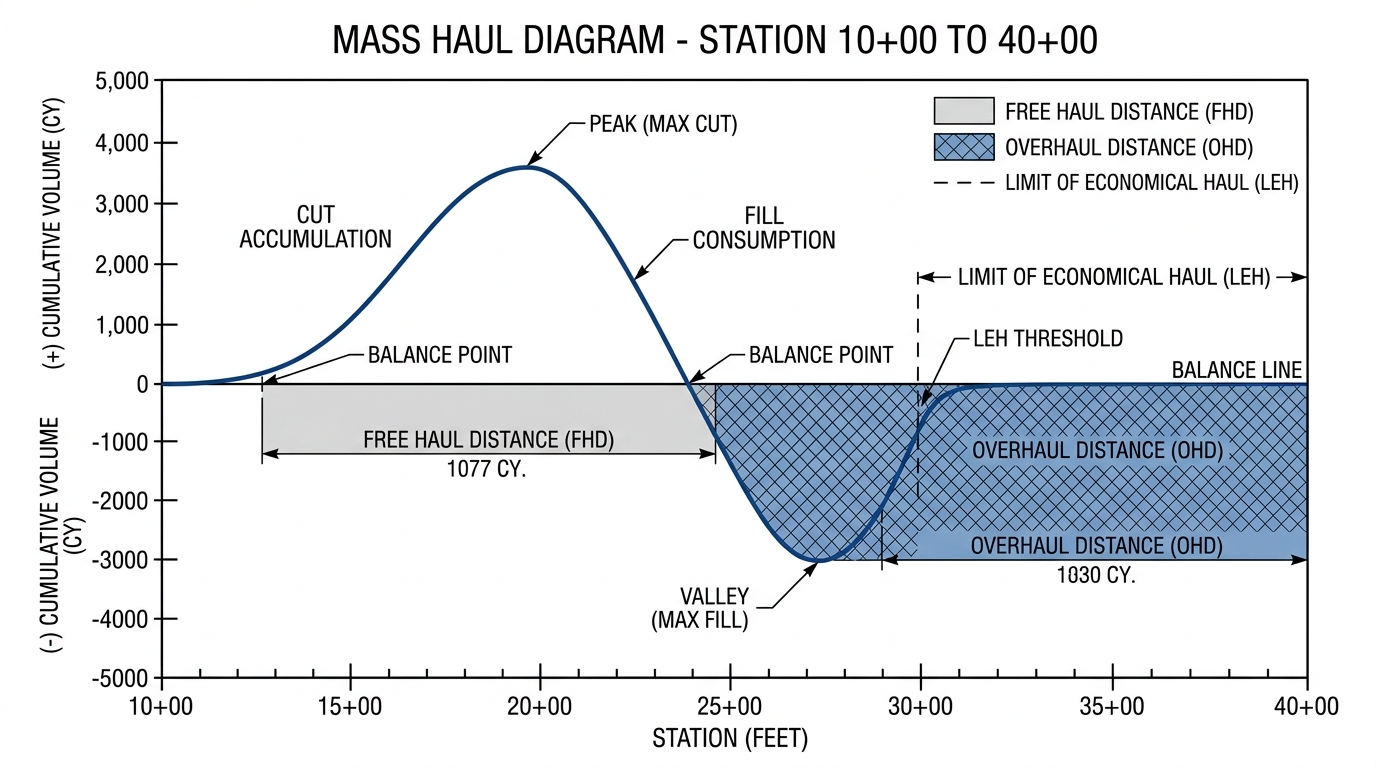
A Mass Haul Diagram (MHD) is a continuous graphical curve plotting cumulative earthwork volume against project baseline stationing (e.g., from Station 0+00 to Station 52+00 along a roadway, airport runway, or commercial arterial spine).
- Rising Curve: Indicates an excavation (Cut) section along the alignment where material is being generated.
- Falling Curve: Indicates an embankment (Fill) section where material is being placed and consumed.
- Peak (Crest): Represents the exact station where grading transitions from cut to fill.
- Valley (Trough): Represents the exact station where grading transitions from fill to cut.
Calculate Station Overhaul & Dirt Balance in Real Time
Use our free contractor tool to compute net site balance, Free Haul thresholds (500 ft or custom), overhaul yard-stations (Sta-Yds), and haul equipment fleet cycle times.
Launch Interactive Mass Haul Calculator →2. The Balance Line and Haul Direction
Any horizontal line drawn across a mass haul diagram is called a Balance Line. Where the balance line intersects the mass haul curve at two points, the net volume of cut between those two stations exactly equals the net volume of compacted fill required:
Forward Haul (Left to Right)
When a loop of the curve rises above the balance line, the cut occurs before the fill. Heavy equipment moves dirt in the direction of increasing stationing (forward haul).
Backward Haul (Right to Left)
When a loop falls below the balance line, the fill occurs before the cut. Heavy equipment must reverse direction or haul excavated material back down the station alignment.
3. Free Haul vs. Overhaul vs. Borrow & Spoil
Public works agencies (State DOTs, US Army Corps of Engineers) and private development contracts structure earthmoving payment based on haul distance thresholds:
| Earthwork Haul Term | Standard Specification Definition | Estimating & Billing Method |
|---|---|---|
| Free Haul Distance (FHD) | The maximum distance (typically 500 ft to 1,000 ft) within which the contractor is required to move dirt without additional compensation beyond the base unclassified excavation unit price. | Included directly in the base cut unit price ($/CY). |
| Overhaul | Material hauled beyond the specified Free Haul Distance. Measured in Cubic Yard Stations (one CY hauled 100 feet beyond FHD). | Paid as a separate unit price item ($/Sta-Yd or $/CY-mile). |
| Borrow (Import) | Deficit occurring when the mass haul curve ends below the baseline. Indicates insufficient on-site cut; structural fill must be purchased from an off-site borrow pit. | Paid as Borrow Excavation ($/CY) + Truck Hauling + Compaction. |
| Spoil / Waste (Export) | Surplus occurring when the mass haul curve ends above the baseline. Indicates excess excavation that cannot be placed on site and must be hauled to an off-site waste site. | Paid as Unclassified Cut ($/CY) + Off-Site Trucking + Dump Tipping Fees. |
4. Equipment Selection Based on Haul Distance
A primary reason earthwork bids fail is matching the wrong heavy machinery fleet to the project's haul distance profile:
5. Shrinkage Factor Adjustment in Mass Haul Math
A fatal error when plotting mass haul curves is failing to adjust fill volumes for compaction shrinkage. If 1,000 Bank Cubic Yards (BCY) of excavated clay yields only 850 Compacted Cubic Yards (CCY) under vibrating roller passes (15% shrinkage), the fill curve must be adjusted upward by dividing CCY by (1 − 0.15 = 0.85). Without this correction, the mass haul diagram will show a false balance, leaving the project thousands of yards short of dirt in the field.
6. Worked Numerical Example: Station-by-Station Overhaul Math
Consider a roadway grading section from Station 10+00 to Station 32+00 with the following project parameters:
Step 1: Calculate Total Haul Distance
Step 2: Determine Overhaul Distance
Step 3: Calculate Overhaul in Yard-Stations
Step 4: Compute Total Overhaul Line Item Compensation
At 1,400 ft haul distance, the contractor deploys a twin-engine wheel tractor-scraper fleet (CAT 627K). The $16,200 overhaul payment directly offsets the additional cycle fuel and scraper tire wear accumulated beyond the 500-foot free push zone.
7. Haul Road Rolling Resistance & Scraper Cycle Time Economics
A mass haul diagram gives horizontal transport distance, but machine travel speed is governed by Total Haul Road Resistance:
• Grade Resistance (GR): ±1.0% for each 1.0% of slope (+ for adverse uphill climb, − for downhill haul assist).
• Haul Cycle Time: Cycle Time (Minutes) = Fixed Time (Load + Dump + Turn, typically 1.5 to 2.2 min) + Variable Travel Time [Distance (ft) ÷ (Speed (MPH) × 88)].
If a haul road has +4% adverse grade on rutted clay (RR = 4%), total resistance is 8%. Scraper speeds drop from 24 MPH to 8 MPH, cutting daily yardage output in half and doubling equipment hourly cost per cubic yard. Professional earthwork estimators incorporate haul road maintenance (dedicated CAT 14M grader + 4,000-gal water truck) into the mass haul budget to maintain high cycle velocities.
8. Connected Estimating Tools & Services
Pair your mass haul analysis with our connected calculation tools and commercial estimating services:
- Interactive mass haul tool: Mass Haul & Overhaul Calculator.
- Soil expansion math: Soil Shrink & Swell Conversion Guide (BCY/LCY/CCY).
- Digital surface meshes: Civil 3D Surface Modeling for Estimating.
- Interactive volume tool: Earthwork Cut/Fill & Truckload Tool.
- Turnkey modeling service: Turnkey 3D Earthwork Cut & Fill Takeoff Services.