Direct Engineering Summary: What Are Soil Shrink and Swell Factors?
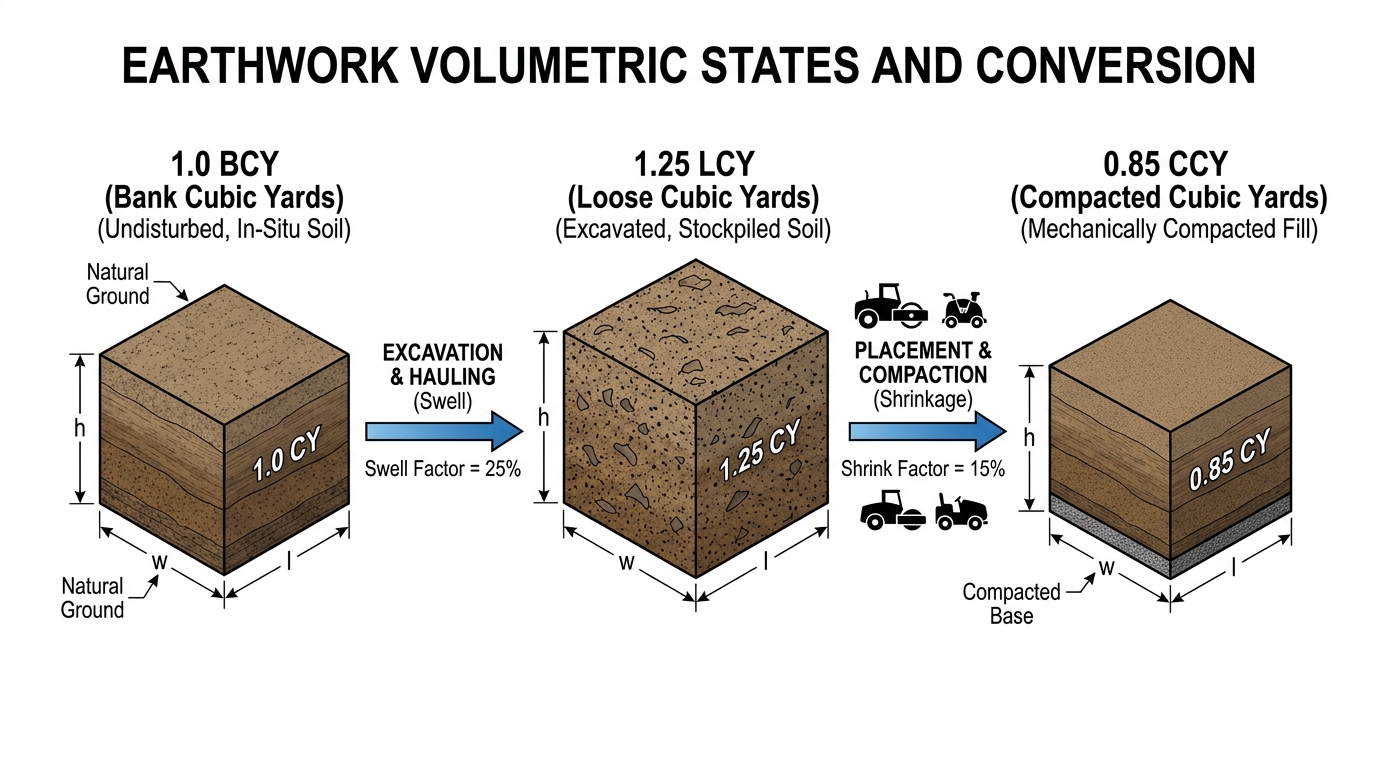
In geotechnical and civil estimating, swell is the percentage increase in volume that occurs when undisturbed, compacted in-situ soil is excavated, fractured, and loosened with air voids (converting Bank Cubic Yards into Loose Cubic Yards). Conversely, shrinkage is the percentage decrease in volume that occurs when excavated soil is placed in thin lifts and mechanically compacted by vibratory or sheepfoot rollers to achieve 95% to 100% Modified Proctor density (converting BCY into Compacted Cubic Yards). Failing to adjust for these factors results in severe truck hauling overruns or imported fill deficits.
1. The Three States of Soil in Earthwork Estimating
In civil construction estimating, failing to distinguish between in-situ bank volume, loose excavated volume, and compacted embankment volume is the single most common cause of catastrophic earthwork bidding losses. Soil exists in three distinct physical states:
Bank Cubic Yards (BCY)
In-situ soil in its natural, undisturbed geological condition prior to excavation. 3D surface DTM models measure cut in pure BCY.
Loose Cubic Yards (LCY)
Soil that has been disturbed, fractured, and loaded. Air voids expand the bulk volume. Critical for determining dump truckload counts.
Compacted Yards (CCY)
Soil placed in engineered fill lifts (typically 6" to 8") and mechanically compacted to 95%+ Standard or Modified Proctor density.
2. Standard Soil Swell & Shrinkage Percentages
While precise values should always be cross-referenced against the project's geotechnical engineering report, the following table details accepted industry averages across common North American soil classifications:
| Soil / Rock Material | In-Bank Density | Swell Factor (%) | Shrinkage Factor (%) | Net BCY to CCY Ratio |
|---|---|---|---|---|
| Clean Sand & Fine Gravel | 2,700 lbs/CY | +12% to +15% | -10% to -12% | 0.88 – 0.90 |
| Common Earth / Sandy Loam | 2,600 lbs/CY | +20% to +25% | -15% to -18% | 0.82 – 0.85 |
| Dense Clay (Plastic / Fat Clay) | 2,800 lbs/CY | +30% to +40% | -18% to -25% | 0.75 – 0.82 |
| Topsoil (Organic Loam) | 2,200 lbs/CY | +25% to +30% | -20% to -30% | 0.70 – 0.80 |
| Solid Blasted Rock / Limestone | 4,200 lbs/CY | +50% to +65% | +20% to +35% (Grows) | 1.20 – 1.35 |
3. Geotechnical Mechanics: Standard vs. Modified Proctor Density
To understand why soil shrinks, an estimator must understand compaction test standards specified in project project manuals:
- Standard Proctor (ASTM D698 / AASHTO T99): Uses a 5.5-lb hammer falling 12 inches with a compactive effort of 12,400 ft-lbf/cu.ft. Common for general landscaped lawn fill and low-load berms.
- Modified Proctor (ASTM D1557 / AASHTO T180): Uses a 10.0-lb hammer falling 18 inches with a compactive effort of 56,250 ft-lbf/cu.ft (4.5 times more energy). Mandated for commercial building pads, DOT highway subgrades, and heavy truck pavements.
Achieving 95% Modified Proctor density expels virtually all air from the soil matrix. An excavation contractor moving native silty sand from a cut zone with 85% in-place relative density into a 98% Modified Proctor building pad will experience an actual shrinkage rate of 18% to 22%—meaning each 10,000 BCY cut yields less than 8,000 CCY of finished pad embankment.
4. The Volumetric Mathematical Formulas
Estimators use standard algebraic conversion formulas to convert cut/fill balances into operational quantities:
5. Real-World Estimator Worked Numerical Example
Suppose a commercial grading plan shows 12,500 CY of gross fill required for an industrial warehouse pad in stiff clay loam. The geotechnical report specifies an 18% compaction shrinkage factor and a 32% swell factor for off-site hauling.
- Net Compacted Fill Required: 12,500 CCY
- Raw Bank Dirt Cut Required: 12,500 ÷ (1 - 0.18) = 15,244 BCY of cut
- Notice: If the contractor only planned for 12,500 BCY, they would face an immediate 2,744 CY shortfall on the building pad. At $18.50/CY for imported fill, that omission creates a $50,764 budget blowout!
- Off-Site Spoil Haul Volume: 15,244 BCY × 1.32 = 20,122 LCY
- Standard Tri-Axle Truckloads (16 LCY capacity): 20,122 ÷ 16 = 1,258 Truckloads
- Tandem Truck Haul Cycles: At $115/hour per truck and 2.5 cycles per day, knowing exact LCY counts determines equipment fleet sizing.
6. Regional Soil Characteristics Across North America
Shrink and swell behavior varies dramatically by geological geography:
7. Five Common Estimator Mistakes with Shrink & Swell
- Confusing Swell with Bulking: Assuming that because soil swells 25% when excavated, it will swell when rolled into an embankment. Loosened soil swells in the haul truck, but shrinks once compacted.
- Averaging Site Soil Factors: Using a single 15% shrinkage factor across a site that contains both clay cut and rock cut. Rock expands while clay shrinks.
- Overlooking Topsoil Organic Shrinkage: Topsoil loam containing high organic matter shrinks 25% to 35% when compacted, meaning stockpiled topsoil will not cover as much surface area as expected.
- Ignoring Truck Axle Weight Limits: Calculating truck capacity purely by volumetric yards (LCY) without checking gross vehicle weight ratings (GVWR). Dense clay at 2,800 lbs/CY will exceed 20-ton road limits before filling the bed.
- Neglecting Moisture Conditioning: Bidding compaction without budgeting for water pull trucks or disk harrows when native soil is 5% dry or wet of Optimum Moisture Content.
8. Connected Estimating Tools & Services
Use our interactive tools and specialized service pages to verify your dirt calculations:
- Instant field conversions: BCY / LCY / CCY Earthwork Volume Calculator.
- 3D Surface Modeling Service: 3D Earthwork Cut & Fill Takeoff Services.
- Balancing Site Dirt: Mass Haul Diagrams & Earthwork Balancing.
- Regional soil nuances: US Regional Soil & Geotech Guide.