Direct Engineering Summary: How Are Utility Trench Quantities Calculated?
An underground utility trench takeoff (CSI MasterFormat Division 33) calculates four core volumetric layers: (1) Gross Trench Excavation (BCY) = [Length × Width × Depth] ÷ 27 binned into OSHA depth brackets (0-6', 6-10', 10-14', 14'+); (2) Pipe Barrel Displacement (CY) = [π × (O.D./2)² × Length] ÷ 27 subtracted from bedding volume; (3) Imported Aggregate Bedding & Haunching Tonnage calculated at 1.45 tons/CY; and (4) Backfill Compaction (CCY) using select granular fill in roadway envelopes or native spoils in green space.
1. The Anatomy of an Underground Utility Trench
Underground utility contractors face unique excavation hazards. Unlike open mass grading where excavators move dirt freely, utility trenching operates within narrow, confined trench envelopes where depth increases equipment cycle times, mandates OSHA shoring systems, and requires precise bedding rock foundations.
Rim-to-Invert Depth vs. Actual Excavation Bottom
Civil plan sheets specify Invert Elevations—the inside bottom elevation of the pipe where water flows. However, the excavator operator cannot stop digging at the invert:
- The excavator must dig deep enough to accommodate the pipe wall thickness (barrel OD).
- The excavator must dig an additional 4 to 8 inches deeper to accommodate the specified aggregate bedding stone cushion beneath the pipe haunch.
- Formula: Total Trench Depth = (Rim Elevation - Invert Elevation) + Pipe Wall Thickness + Bedding Thickness
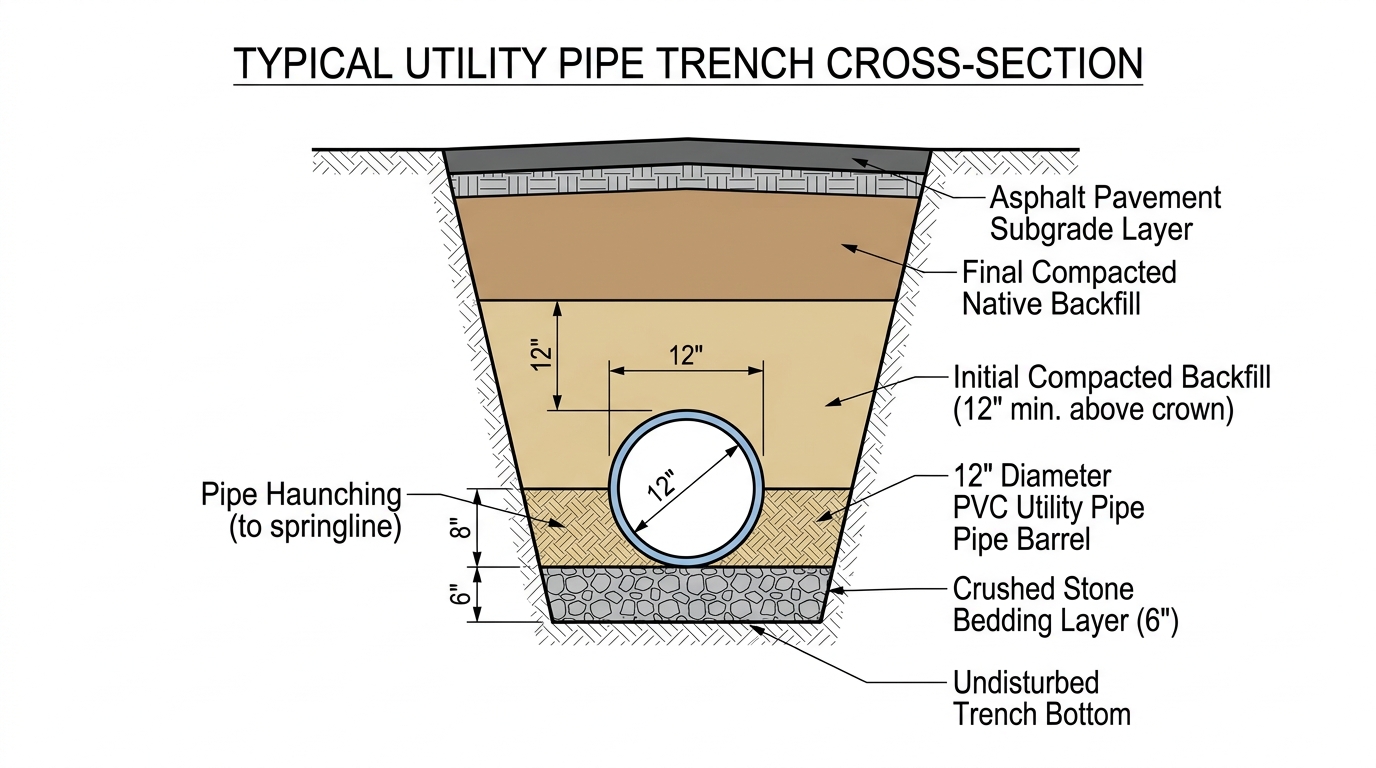
Trench Cross-Section Engineering Detail: Demonstrating trench bottom subgrade, crushed stone bedding envelope, pipe barrel haunching, initial cover, and trench backfill zones.
2. The Four Critical Depth Brackets (0–6', 6–10', 10–14', 14'+)
In professional CSI Division 33 estimating, an estimator who prices all pipe runs at a single average depth will lose bids on shallow runs and lose tens of thousands of dollars on deep runs. Production rates and equipment sizes vary drastically across four standardized depth brackets:
Depth Bracket 1: 0 to 6 Feet (Shallow Service Work)Typically includes water service lines, shallow roof drain lines, and dry electrical conduit. Trenches under 5 ft do not require OSHA shoring unless hazardous ground is encountered. Fast machine production (300–600 LF/day).
Depth Bracket 2: 6 to 10 Feet (Standard Mainline Depth)The standard depth for commercial gravity sanitary sewer mains and storm trunklines. Requires a certified aluminum or steel trench shield (trench box). Production rates drop to 150–300 LF/day.
Depth Bracket 3: 10 to 14 Feet (Deep Gravity Work)Requires large-class excavators (Cat 336 / Komatsu PC360 or larger) capable of lifting stacked heavy trench shields. Excavated soil must be placed at least 2 ft away from the trench lip (OSHA spoil pile rule). Production slows to 75–150 LF/day.
Depth Bracket 4: 14+ Feet (Extreme Deep Infrastructure)Frequently encounters groundwater tables requiring active wellpoint dewatering. May require slide-rail shoring systems or benching. Production drops under 50 LF/day. Costs per linear foot can triple compared to 8 ft trenches.
3. Mathematical Formulas: Excavation, Displacement & Bedding
Use these exact mathematical equations when setting up your estimating spreadsheets or validating civil bids:
Equation 1: Total Trench Excavation Volume (Cubic Yards)
Total Excavation (CY) = [Trench Width (ft) × Avg Depth (ft) × Run Length (ft)] / 27
Note: If sloping trench walls per OSHA Type B soil (1:1 slope), replace width with average width: [(Bottom Width + Top Width) / 2].
Equation 2: Pipe Displacement Volume (Cubic Yards)
Pipe Displacement (CY) = [π × (Outside Diameter / 2)² × Run Length (ft)] / 27
This volume MUST be deducted from the bedding and pipe embedment zone to avoid massively overbuying crushed stone aggregates.
4. Converting Cubic Yards to Bedding Stone Tonnage
Quarries bill pipe bedding material by the ton, not by the cubic yard. Standard pipe bedding specifications (such as ASTM C33 concrete sand or AASHTO No. 57 crushed limestone) typically weigh:
- No. 57 Crushed Stone: Approximately 1.40 to 1.50 tons per compacted cubic yard (1.45 T/CY is standard).
- Pipe Bedding Sand / Fine Aggregate: Approximately 1.35 to 1.45 tons per CY depending on moisture content.
Test these calculations instantly in our free Utility Trench Excavation & Bedding Calculator, which automatically computes displacement and stone tonnages across PVC, RCP, and HDPE pipe materials.
5. Precast Utility Structure Takeoffs
In addition to pipe linear footage, every complete CSI Division 33 takeoff must tally and categorize structures by depth and diameter:
- Sanitary Manholes: Categorized by diameter (48", 60", 72") and total vertical depth from rim to lowest invert channel.
- Storm Inlets & Catch Basins: Curb inlets (Type A/C), grated drop inlets, and junction boxes.
- Headwalls & Dissipators: Concrete flared end sections, headwalls with safety grates, and riprap aprons (SY and tons of rock).
6. OSHA 1926 Subpart P: Trench Sloping, Benching & Shield Sizing
Safety regulations dictate trench width, machine sizes, and cycle times. Estimators must evaluate soil classifications per OSHA 29 CFR 1926 Subpart P:
| OSHA Soil Type | Unconfined Compressive Strength | Permissible Trench Slope Angle | Estimating & Shoring Impact |
|---|
| Stable Rock | Indurated solid bedrock | Vertical (90°) | Requires hydraulic hammer breakers; no trench box needed. |
| Type A Soil | ≥ 1.5 tons/sq.ft (tsf) (Dense Clay / Hardpan) | 3/4 : 1 Slope (53° angle) | Requires 1.5 ft of horizontal width per 1.0 ft of depth if sloping. |
| Type B Soil | 0.5 to 1.5 tsf (Silt, Sandy Loam, Fractured Clay) | 1 : 1 Slope (45° angle) | Standard commercial site soil; mandates 8x16 or 8x20 steel trench box shields. |
| Type C Soil | < 0.5 tsf (Submerged Sand, Gravel, Mud) | 1.5 : 1 Slope (34° angle) | Triples open-cut excavation yardage; slide rail shoring or tight sheeting required. |
7. Worked Numerical Example: 24-Inch Storm Sewer Trench Math
Consider a 500-LF storm drainage run of 24-inch Reinforced Concrete Pipe (RCP Class III) installed at an average depth of 9.0 feet in Type B soil using an 8-foot wide trench box:
• Pipe Inside Diameter: 24.0 inches (2.00 ft) | Wall Thickness: 3.75 inches | Outside Diameter (O.D.): 31.5 inches (2.625 ft)
• Trench Excavation Bottom: 4.5 ft width inside trench box shield.
• Bedding Stone Specification: 6" bedding beneath barrel + haunching up to springline (15.75" above bedding). Total Stone Envelope = 21.75 inches (1.81 ft).
- Gross Trench Excavation: [500 LF × 4.5 ft width × 9.0 ft depth] ÷ 27 = 750.0 BCY.
- Gross Bedding Zone Envelope: [500 LF × 4.5 ft × 1.81 ft] ÷ 27 = 150.8 CY.
- Pipe Half-Cylinder Displacement: [π × (2.625 ÷ 2)² × 500 ÷ 2] ÷ 27 = 50.1 CY.
- Net AASHTO #57 Bedding Stone: (150.8 CY − 50.1 CY) = 100.7 CY × 1.45 Tons/CY = 146.0 Tons of Bedding Stone.
- Intermediate Native Backfill: Gross Cut (750.0 CY) − Gross Bedding (150.8 CY) = 599.2 BCY compacted in 8-inch lifts.
Need an Itemized Division 33 Utility Takeoff?
Sitework Estimate prepares complete station-by-station pipe schedules, invert profile cuts, structure tallies, and Excel bid sheets for utility subcontractors nationwide.