Site Demolition & Clearing Takeoff Services
Win competitive excavation bids with itemized pre-construction demolition quantities. We extract exact acreage of clearing & grubbing, caliper tree removals, asphalt sawcuts, concrete pavement demolition tonnage, and debris disposal truckloads.
Demolition Takeoff Deliverables
- Clearing & Grubbing: Heavy timber vs light brush acreage
- Tree Removal Schedules: Categorized by caliper inch brackets
- Pavement Sawcutting: Linear feet of full-depth asphalt & curb cuts
- Pavement Demolition Tonnage: Asphalt SY & concrete tons calculated
- Utility Removals & Capping: Pipe LF removal & structure demolitions
- Disposal Hauling Analysis: Loose volume & dump truck cycles
Direct Technical Summary: What Is a Site Demolition and Clearing Takeoff?
A civil site demolition and clearing takeoff is the pre-construction engineering quantification of all surface vegetation, existing pavement structures, and subsurface utility elements required to be removed or demolished prior to earthmoving. Governed by CSI MasterFormat Division 02 41 00 (Demolition) and Division 31 10 00 (Site Clearing), it itemizes acreage of heavy timber vs. light scrub clearing, tree removals by caliper diameter (6"-12", 12"-24", 24"+), asphalt pavement sawcuts (LF) and demo tonnage, concrete flatwork/curb breaking (tons), underground utility pipe extraction or flowable fill abandonment (LF/CY), and debris trucking disposal haul counts.
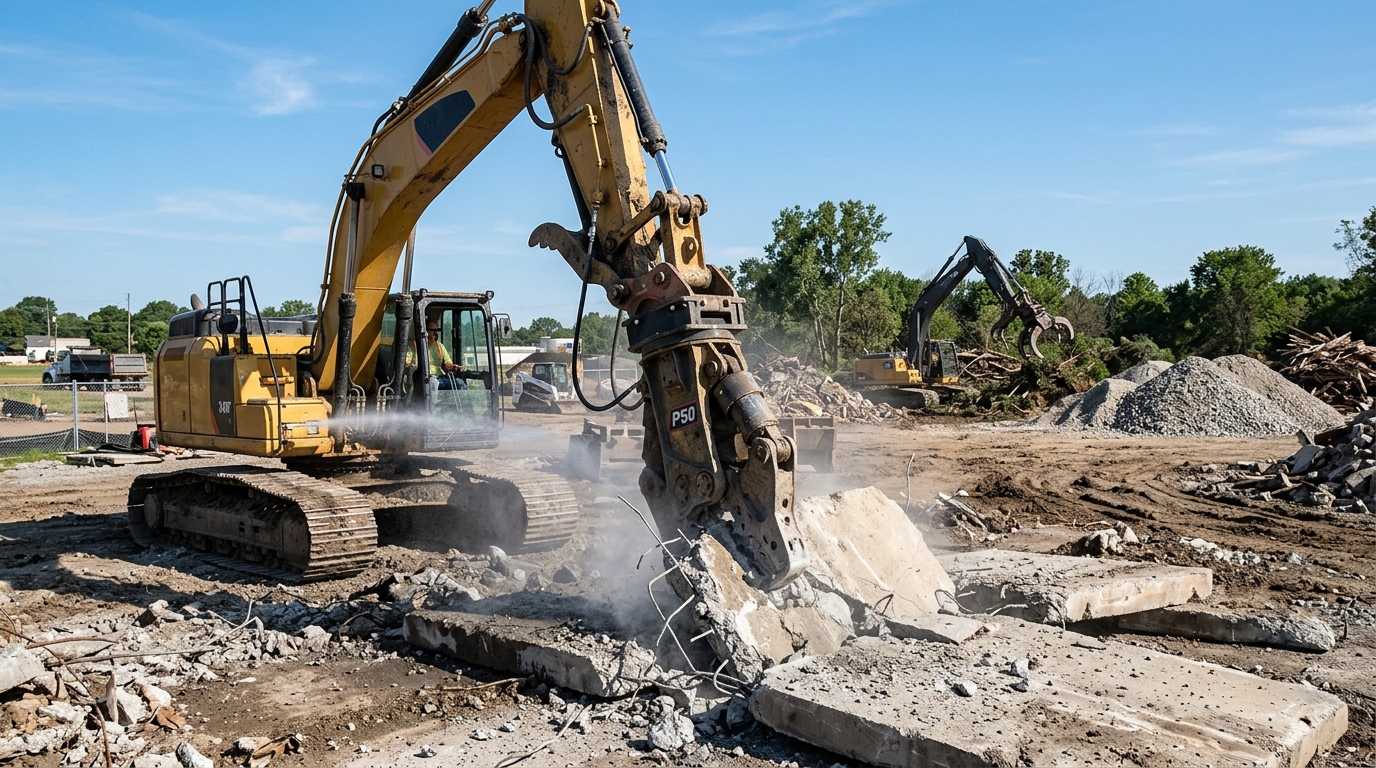
Why Civil Demolition Takeoffs Determine Earthwork Profitability
Site clearing and demolition represent the very first boots-on-the-ground operations of any civil development project. If an excavation contractor undercounts existing pavement thickness, misses buried foundation footings, or fails to quantify root grubbing depth, their initial cash flow is compromised before mass earthmoving even begins.
Our civil estimating team cross-references existing topography surveys, demolition plans (C-100 sheets), ALTA boundary surveys, and geotechnical borings to deliver an unassailable bill of materials for your bid.
Vegetation & Tree Clearing
We quantify clearing limits in square yards and acres. Trees are cataloged by caliper ranges (6"-12", 12"-24", 24"+) and stump grubbing depths are calculated to ensure proper backfill volume accounting.
- Wooded timber vs scrub acreage
- Tree preservation fencing LF
- Root mat grubbing deduction
Pavement & Slab Demolition
Pavement surfaces require precise density conversions. We calculate sawcutting linear footage, asphalt breaking (SY and tons at 145 lbs/cf), reinforced concrete slab removal, and curb demolition LF.
- Full-depth perimeter sawcuts (LF)
- Asphalt wearing & base removal (Tons)
- Concrete curb & sidewalk breaking (SY/LF)
Utilities & Subsurface Demo
Existing utilities within the proposed building pad or roadway alignment must be addressed. We quantify water line cuts, sanitary sewer grouting/abandonment, storm pipe removal, and septic tank pumping/demolition.
- Pipe excavation & disposal (LF)
- Flowable fill pipe abandonments (CY)
- Catch basin & manhole demolitions (EA)
Mathematical Takeoff Modeling: Pavement Tonnage & Disposal Truckloads
Demolition estimating hinges on accurate weight-to-volume conversions and swell factors. Below is the mathematical standard utilized in our civil demolition spreadsheets:
1. Pavement Demolition Weight Formulas
Asphalt Tonnage = [Area (SY) × Thickness (Inches) × 112.5 lbs] ÷ 2,000 lbsConcrete Tonnage = [Area (SY) × (Thickness/36) × 27 CF × 150 lbs/CF] ÷ 2,000 lbsCurb Demolition = Linear Feet (LF) × 0.055 CY/LF × 2.025 Tons/CY
2. Debris Bulking & Trucking Formulas
Broken Concrete Swell = Solid Volume (CY) × 1.45 (45% void expansion)Asphalt Millings Swell = Solid Volume (CY) × 1.25 (25% expansion)Truck Loads = Total Loose Tons ÷ Legal Axle Load (typically 18 to 21 Tons/Tandem)
• 3.5 Acres Clearing & Grubbing (2.0 AC heavy oak timber, 1.5 AC brush) + 28 Caliper Trees (18"-24").
• 7,200 SY of 3.5" Asphalt Pavement Removal: [7,200 × 3.5 × 112.5] ÷ 2,000 = 1,417.5 Tons of Asphalt Rubble.
• 1,800 LF of Perimeter Full-Depth Asphalt Sawcutting.
• 2,400 SY of 6" Reinforced Concrete Apron Demo: [2,400 × (6/36) × 27 × 150] ÷ 2,000 = 810.0 Tons of Concrete Rubble.
• 1,400 LF of Concrete Curb & Gutter Demo: 1,400 × 0.055 × 2.025 = 155.9 Tons of Curb Concrete.
• Total Debris Haul = 1,417.5 + 810.0 + 155.9 = 2,383.4 Tons = 119 Legal Tandem Dump Truck Loads (at 20 tons/load).
Standard Civil Demolition Pay Items & Takeoff Formulas
| CSI Code | Scope Description | Measurement Unit | Standard Density / Conversion | Haul Multiplier |
|---|---|---|---|---|
| 31 11 00 | Clearing & Grubbing | Acres / SY | LOD boundary perimeter area | Tub grinder or burn pile |
| 02 41 13.13 | Full Depth Asphalt Sawcut | Linear Feet (LF) | Measured along perimeter tie-in seams | Direct labor / blade wear |
| 02 41 13.23 | Asphalt Pavement Removal | Square Yards / Tons | 145 lbs/cu ft (approx. 112 lbs/sy-in) | 1.30 swell to loose tons |
| 02 41 13.33 | Concrete Pavement / Slabs | Square Yards / Tons | 150 lbs/cu ft (reinforced concrete) | 1.45 broken rubble swell |
| 02 41 16.13 | Concrete Curb & Gutter Removal | Linear Feet (LF) | 150 to 220 lbs per LF (by profile) | Dump trailer hauling |
| 33 05 09 | Existing Pipe Demolition | Linear Feet (LF) | Segregated by diameter & material (RCP, PVC, CMP) | Backhoe trench removal |
Site Demolition & Clearing Takeoff Specifications & Quality Control Matrix
| Takeoff Parameter | Standard Service Specification |
|---|---|
| Measurement Units | Acres (AC clearing & grubbing), Linear Feet (LF sawcutting & pipe removal), Square Yards & Tons (SY/TN asphalt & concrete demo), Each (EA tree removals by caliper diameter & structure demolitions). |
| Drawings Reviewed | Existing Topography & Boundary Surveys (C100), Demolition & Tree Protection Plans (C110), Utility Abandonment Plans, and ALTA Title Surveys. |
| Specification Alignment | CSI MasterFormat Division 02 41 00 (Demolition) & 31 10 00 (Site Clearing). |
| Revisions & Addenda | Tracked revisions to Limit of Disturbance (LOD), modified tree preservation boundaries, or additional sawcutting scopes detailed with line-item delta tracking. |
| QA/QC Review Protocol | Senior civil estimator cross-check verifying existing pavement thicknesses against geotechnical core borings, tree preservation fence closures, and utility cap locations. |
| Standard Exclusions | Hazardous materials abatement (asbestos pipe insulation, lead paint), commercial building structural interior demolition, and municipal dump tipping gate fees. |
Five Costly Demolition Bidding Pitfalls We Help You Avoid
Downstream Earthwork Integration
Demolition quantities directly impact your dirt balance. When we model your cut/fill, we subtract the stripped root mat and demolished asphalt depths to ensure existing surface elevations accurately reflect the raw earth beneath.
Demolition Guides & Decision Resources
Review our comprehensive demolition and contractor pre-bid resources:
Frequently Asked Questions
How do you quantify clearing and grubbing from civil drawings?
We delineate project limits of disturbance (LOD) and clearing boundaries on civil site demolition plans. We separate heavy wooded timber from light brush/scrub acreage and isolate individual caliper-sized trees designated for removal or preservation.
How is existing asphalt and concrete pavement demolition calculated?
Pavement removal is measured in square yards and converted to tons based on specific core thicknesses (e.g., 3-inch asphalt vs. 6-inch reinforced concrete). We also quantify linear footage of sawcuts and distinguish between salvageable crushed aggregate and disposal hauling.
Are existing utility line removals included in demolition takeoffs?
Yes. We quantify linear footage of pipe to be excavated and removed, pipes to be abandoned in place with flowable grout fill, and utility structures (manholes, catch basins, septic tanks) slated for demolition and backfill.
What is the standard swell factor for demolished concrete and asphalt?
In-place solid pavement swells significantly when broken into rubble. Demolished asphalt swells 30% to 35% (1.30-1.35 multiplier), while reinforced concrete broken with hydraulic breakers swells 40% to 50% (1.40-1.50 multiplier) due to irregular voids and tangled rebar, directly impacting dump truck trucking cycle requirements.
How are tree protection zones and root mat grubbing quantified?
We quantify tree protection fencing (orange high-visibility barrier or chain-link) in linear feet, and model root mat grubbing as an independent 6 to 12-inch topsoil stripping layer to ensure accurate rough earthwork cut/fill balances.
Ready for an Itemized Demolition & Clearing Takeoff?
Upload your civil demolition plans, ALTA surveys, and site notes. We deliver a verified, spreadsheet-ready bill of materials within 24 to 48 hours.