Erosion Control & SWPPP Takeoff Services
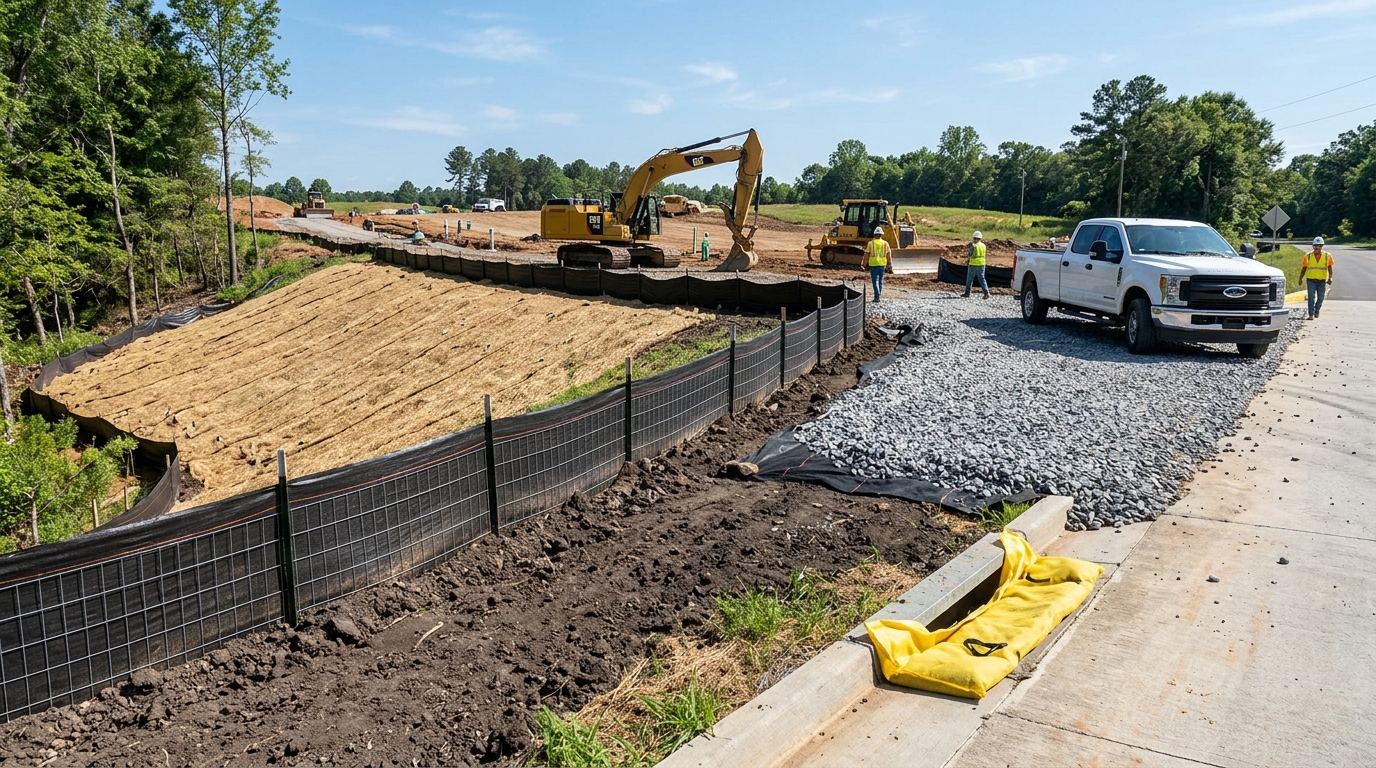
Protect your bid margins and satisfy regulatory compliance. We provide complete quantity takeoffs for civil SWPPP sheets, including silt fence, stabilized construction entrance stone, inlet filter sacks, sediment traps, and slope stabilization matting.
SWPPP BMP Takeoff Deliverables
- Perimeter Silt Fence: Standard & wire-backed LF + stake counts
- Construction Entrances: Crushed stone ballast tons & geotextile SY
- Inlet Protection: Drop inlet filter bags & curb sediment barriers (EA)
- Sediment Basins & Traps: Excavation volume, rock baffles & skimmers
- Erosion Control Blankets: Curlex/straw mats (SY) + staple counts
- Temporary Seeding: Disturbed earth acreage & mulch requirements
Direct Technical Summary: What Is an Erosion Control and SWPPP Takeoff?
An erosion and sediment control takeoff is the engineering quantification of all temporary and permanent Best Management Practices (BMPs) mandated by the EPA National Pollutant Discharge Elimination System (NPDES) Construction General Permit and governed under CSI MasterFormat Division 31 25 00. It spans three distinct construction phases: Phase 1 Initial Clearing (perimeter silt fence LF, stabilized construction entrance stone tons, tree protection fencing LF), Phase 2 Mass Earthwork (temporary sediment traps BCY, rock check dams, temporary seeding AC), and Phase 3 Final Stabilization (inlet protection bags EA, slope erosion control blankets SY, and turf reinforcement mats).
Eliminating Bid Day Scope Gaps on Erosion & Sediment Controls
Every permitted construction project across the United States requires an EPA NPDES General Permit or state Department of Environmental Protection (DEP/DEQ) Stormwater Pollution Prevention Plan (SWPPP).
Too often, general contractors treat erosion control as an afterthought allowance, leading to tens of thousands in unbudgeted costs for stone tracking pads, replacement silt fence, and hydroseeding fines. Our dedicated takeoffs extract every Best Management Practice (BMP) specified across Civil ESC plan sheets.
Perimeter Sediment Barriers
We trace project boundaries and downstream drainage contours to measure linear footage of silt fence. We distinguish standard 36" fabric from heavy-duty wire-backed silt fence and super silt fence with steel posts.
- Standard vs wire-backed silt fence (LF)
- Hardwood stakes or steel T-posts
- Straw wattle / compost filter berms (LF)
Stabilized Site Entrances
Vehicle tracking pads prevent mud from dragging onto public roadways. We calculate crushed stone ballast tonnage (AASHTO #1 to #3 stone) based on specified dimensions (e.g. 50'x20'x6") and underlying woven geotextile fabric SY.
- AASHTO #1-#3 aggregate ballast (Tons)
- Class 1 woven geotextile underlayment (SY)
- Tire wash rack options where specified
Slope & Inlet Protection
Inlets must be protected from sediment loading before paving. We itemize drop inlet filter sacks, curb inlet gravel rings, temporary rock check dams, and net square yards of Erosion Control Blankets (ECB) with staples.
- Inlet sediment filter bags (EA)
- Riprap check dams & stone filters (Tons)
- Curlex/jute erosion control blankets (SY)
Mathematical Takeoff Modeling: Ballast Stone, Blankets & Silt Fence
Erosion control pricing requires engineering conversion formulas to properly calculate purchasing units from civil drawing geometry:
1. Tracking Pad Ballast Stone Formula
Ballast Stone (Tons) = [Length (ft) × Width (ft) × Depth (ft) ÷ 27] × 1.90 Tons/CYUnderlayment Fabric (SY) = [Length (ft) × Width (ft)] ÷ 9- Typical tracking pad: 70' × 24' × 0.67' (8") = 41.7 CY = 79.2 Tons AASHTO #1 Stone + 187 SY Woven Fabric.
2. Slope Erosion Blanket & Staple Formula
Gross Matting (SY) = Net 3D Slope Area (SY) × 1.15 (15% overlap allowance)Anchoring Staples (EA) = Gross Matting (SY) × 3.5 staples/SYStandard Straw Rolls = Gross SY ÷ 100 SY/Roll (e.g. 8' × 112.5' rolls)
• 3,600 LF of Standard Silt Fence along property boundaries (360 hardwood stakes at 10' OC).
• 1,400 LF of Wire-Backed Silt Fence along steep 3:1 basin daylight perimeters (233 steel T-posts at 6' OC).
• 2 Stabilized Construction Entrances (70' × 24' × 8"): 2 × 79.2 Tons = 158.4 Tons AASHTO #1 Stone + 374 SY Class 1 Woven Geotextile.
• 28 Drop Inlet Filter Bags & 14 Curb Inlet Gravel Barriers: 42 EA Inlet Protection Assemblies.
• 5,400 SY of Detention Basin 3:1 Slope Stabilization: 5,400 × 1.15 = 6,210 SY Single-Net Straw Matting (63 rolls) + 21,735 Wire Staples.
• 8.5 Acres Temporary Seeding & Straw Mulching during interim earthwork phases.
Standard SWPPP BMP Pay Items & Takeoff Formulas
| CSI Code | BMP Description | Bid Unit | Material Specification | Standard Takeoff Multiplier |
|---|---|---|---|---|
| 31 25 13.13 | Standard Silt Fence | Linear Feet (LF) | AASHTO M288 woven geotextile, 1.5"x1.5" hardwood stakes | 1 stake per 6' to 10' LF |
| 31 25 13.23 | Wire-Backed Silt Fence | Linear Feet (LF) | 14-gauge 6x6 welded wire mesh with steel T-posts | 1 T-post per 6' LF (1.25 lbs/ft) |
| 31 25 14.13 | Construction Entrance Pad | Tons / SY | AASHTO #1-#3 coarse stone (2"-3") over woven fabric | ~1.9 tons per CY compacted |
| 31 25 14.23 | Inlet Protection Silt Sacks | Each (EA) | High-flow woven sediment catch bag under catch basin grate | 1 EA per proposed structure |
| 31 25 16.13 | Erosion Control Blanket (ECB) | Square Yards (SY) | Single/double net agricultural straw or wood curlex | Net area + 15% overlap factor |
| 31 25 16.23 | Temporary Seeding & Mulch | Acres / SY | Quick-germinating annual rye/millet + straw mulch (2 tons/ac) | Perimeter cut/fill slopes |
Erosion Control & SWPPP Takeoff Specifications & Quality Control Matrix
| Takeoff Parameter | Standard Service Specification |
|---|---|
| Measurement Units | Linear Feet (LF silt fence/wattles), Tons (TN tracking pad ballast rock), Square Yards (SY erosion blanket & turf reinforcement mats), Acres (AC hydroseeding/mulching), Each (EA inlet filter bags/concrete washout basins). |
| Drawings Reviewed | Civil SWPPP & Erosion Control Plans (C500), Phasing Drawings (Initial Clearing Phase vs Mass Grading Phase vs Final Stabilization Phase), and BMP Standard Details. |
| Specification Alignment | CSI MasterFormat Division 31 25 00 (Erosion and Sedimentation Controls) & EPA NPDES Construction General Permit standards. |
| Revisions & Addenda | Phased delta tracking: changes to limit of disturbance (LOD), sediment basin sizing modifications, and upgraded BMP requirements reflected in line-item updates. |
| QA/QC Review Protocol | Environmental compliance verification checking continuous perimeter sediment barriers along downslope contours, inlet protection at every low-point structure, and proper slope netting overlap allowances (12% to 15%). |
| Standard Exclusions | State EPA NPDES Notice of Intent (NOI) filing fees, daily/weekly certified SWPPP on-site storm inspections, and permanent flocculant chemical treatment systems (unless requested). |
Five Costly SWPPP Bidding Mistakes We Help You Avoid
Calculate Quantities in the Field
Use our interactive Erosion Control & SWPPP BMP Calculator to calculate linear silt fence runs, construction entrance stone tons, and blanket roll requirements instantly.
SWPPP Guides & Decision Resources
Access our engineering guides for site sediment control and bid verification:
Frequently Asked Questions
How do you calculate stabilized construction entrance stone quantities?
We extract entrance dimensions from civil erosion control details (typically 50-70 ft length x 20-24 ft width x 6-12 inch depth of AASHTO #1, #2, or #3 ballast stone). We calculate volume, multiply by stone compaction density (approx. 1.8 to 2.0 tons/CY), and quantify underlying Class 1 woven geotextile fabric in square yards.
What is the difference between standard and wire-backed silt fence takeoffs?
Standard silt fence uses woven geotextile fabric with pre-attached hardwood stakes spaced at 6 to 10 feet for mild slopes. Wire-backed silt fence includes 14-gauge welded wire reinforcement mesh and heavy-duty steel T-posts for high-velocity runoff zones and steep cut/fill daylight perimeters.
Are temporary seeding, mulching, and erosion blankets included in takeoffs?
Yes. We quantify disturbed soil acreage requiring temporary seeding and straw mulching during interim earthwork phases, as well as permanent hydroseeding. For slopes steeper than 3:1, we measure Erosion Control Blankets (ECB) or Turf Reinforcement Mats (TRM) in net square yards with a 10% to 15% overlap allowance.
How are SWPPP phasing transitions quantified across clearing, mass grading, and paving?
We review phased ESC drawings to segregate Phase 1 initial clearing controls (perimeter silt fence and tracking pads), Phase 2 mass grading controls (temporary sediment traps, rock check dams, and slope diversions), and Phase 3 final stabilization (inlet filter bags, permanent turf blankets, and sodding).
What overlap and waste factor is calculated for erosion control blankets?
Manufacturer installation specifications mandate a minimum 4 to 6-inch longitudinal overlap and 12-inch transverse terminal overlap, plus anchoring staples spaced every 1.5 to 2.0 feet. We add a standard 12% to 15% material allowance to net slope area to ensure sufficient roll ordering.
Need an Itemized Erosion Control & SWPPP Takeoff?
Upload your civil erosion and sediment control (ESC) plan sheets and details. Receive a certified, bid-ready CSI Division 31 25 00 takeoff spreadsheet in 24 to 48 hours.